Beef It's What's for Dinner Cattletoday.com
Air Engagement: Calendar week of August i, 2014
stream/download this segment every bit an MP3 file
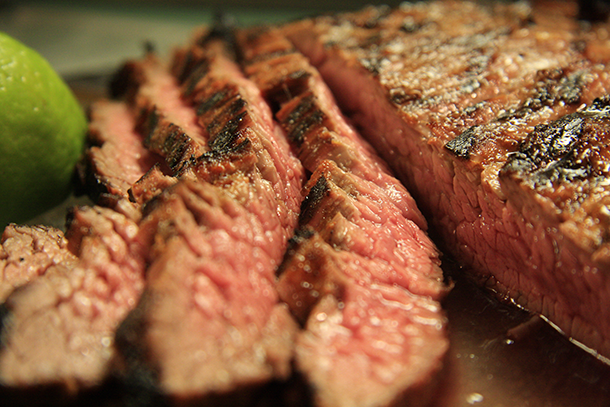
Beef may be what's for dinner only a National Academy of sciences report finds that beef is on average x times worse for the environment than other meats. Nutrient systems good Anna Lappé discusses the beefiness burden and how to swallow healthily with host Steve Curwood.
Transcript
CURWOOD: Well, however it's raised, many Americans find a juicy sizzling steak difficult to resist. But a study published in the Journal of the Proceedings of the National Academy of Sciences shows that producing beef places a greater burden on the surroundings than, say, chicken or pork. Beef cattle crave 28 times more country, and produce v times more greenhouse gases than other livestock. This is an result that Anna Lappé, writer of "Nutrition for a Hot Planet" feels strongly about.
LAPPÉ: When I think about beef, I sort of picture information technology as similar the Hummer on our dinner plate; that's a really inefficient way to go food from an animal. Information technology takes nearly 30 calories of feed to produce simply one calorie of beef, and so, when you think about that conversion ratio, it gets yous thinking near how many resources are going in to produce beef. Worldwide, virtually three-fifths of all agricultural land is used for pasture or for feed, but we're only getting about 5 per centum of the world's protein from beefiness. And beefiness is just an incredibly energy and resource intensive food product arrangement.
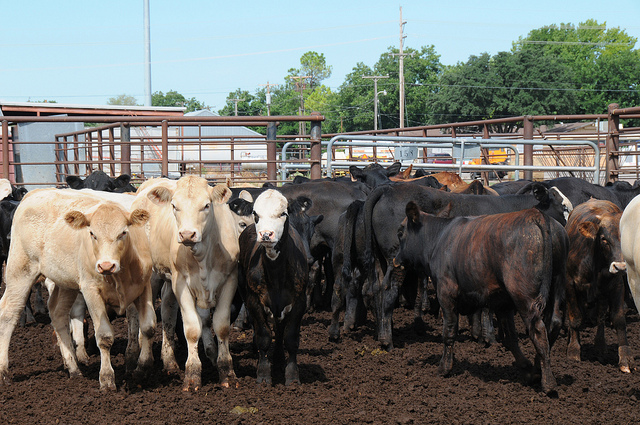
Many, if not most American beef cattle are fattened upward in feedlots on a diet of corn and soy earlier slaughter. (Photo: U.South. Department of Agriculture; Flickr Authorities Piece of work)
CURWOOD: Let's talk about the resources that get into raising beef. What sort of things are used?
LAPPÉ: One of the reasons why beefiness cattle in particular has such a huge affect is because we are raising cattle today in feedlots, and so a large ecology impact is that corn and soy production—it's the water used to grow the corn; it'south the nitrogen runoff from those cornfields. Then that's one of the main sources of impacts.
CURWOOD: At present how does beef compare to other meat production: chicken, pigs, and to the vegetarian options?
LAPPÉ: So when you're looking on average, comparing beef to other forms of meat that Americans typically eat, beef cattle uses about 11 times more irrigated water and produces five times more than greenhouse gas emissions, and half dozen times more nitrogen. Also, producing a pound of beef uses almost 50 times more than h2o than growing a pound of vegetables, and nigh 40 times more than growing potatoes and other root crops, and about nine times more grains.
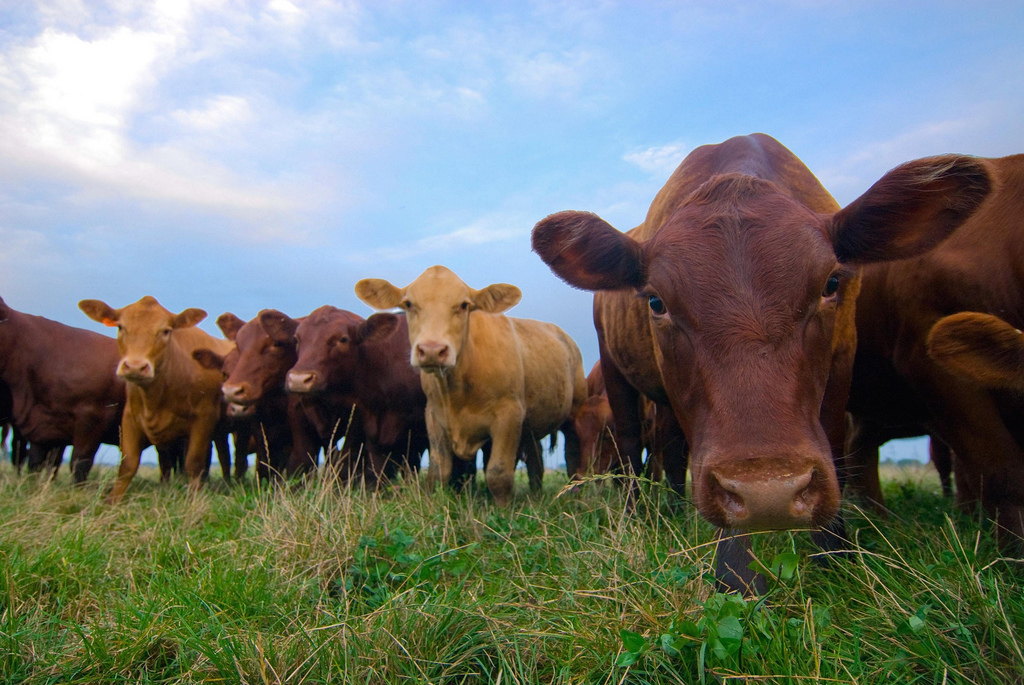
Beef production requires much more state, energy, and water compared port and poultry production, according to a study published by the National Academy of Sciences. (Photograph: theglobalpanorama; Flickr Creative Eatables 2.0)
CURWOOD: What proportion of crops such every bit corn and soy are grown to feed beef as opposed to people direct?
LAPPÉ: Less than ane percent of the corn planted today really is corn like y'all and I retrieve of it, on the cob, we slather with butter and salt. About 50 pct of it's going to feedlots, and a little flake less than 50 pct to corn-based ethanol. One of the elements of a feedlot is that you're concentrating all that livestock, which means you're concentrating their waste—and I don't want it upsetting anyone's appetite here—just when you lot concentrate that waste product, there's going to be not just baneful fumes, only also you can actually encounter the bubbles popping on the pinnacle of these manure lagoons, releasing methane gas—a actually intensive greenhouse gas that traps heat in the atmosphere. And corn and soy are incredibly difficult for cows to digest because they weren't evolved to swallow that nutrition.
CURWOOD: So why not just feed them grass instead of all that soy and corn?
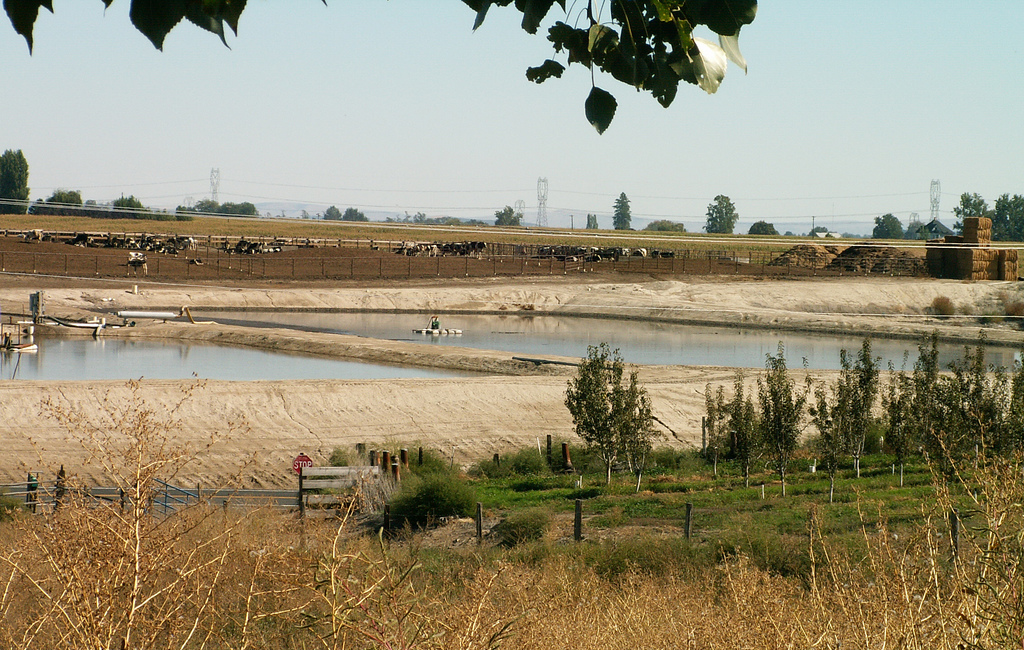
Manure from feedlots is oft is nerveless into lagoons that can emit methane, a powerful global warming gas. (Photo: Socially Responsible Agriculture; Creative Eatables 2.0)
LAPPÉ: In that location'south a big move to raise the alarm and say, "Permit's bring cattle back to the land. Let's feed them what they are designed to eat, which is grass." Simply we have to have a conversation about reducing consumption. We simply cannot produce 26 billion pounds of beef, which is how much we produce every twelvemonth, at a sustainable level. So we need to reduce consumption, and we need to re-call back how we are raising cattle, to integrate them into really thriving sustainable farms and that ways feeding them grass, exactly, getting back on the land.
CURWOOD: And you're talking almost America here?
LAPPÉ: Yes, and so the United States is the world's single largest producer of feedlot beefiness. We export some of that but we consume a lot of that.
CURWOOD: Then, Anna, you lot've given us the math about moo-cow products having such a huge ecology cost, just at the store, relatively inexpensive, certainly compared to seafood, for example.
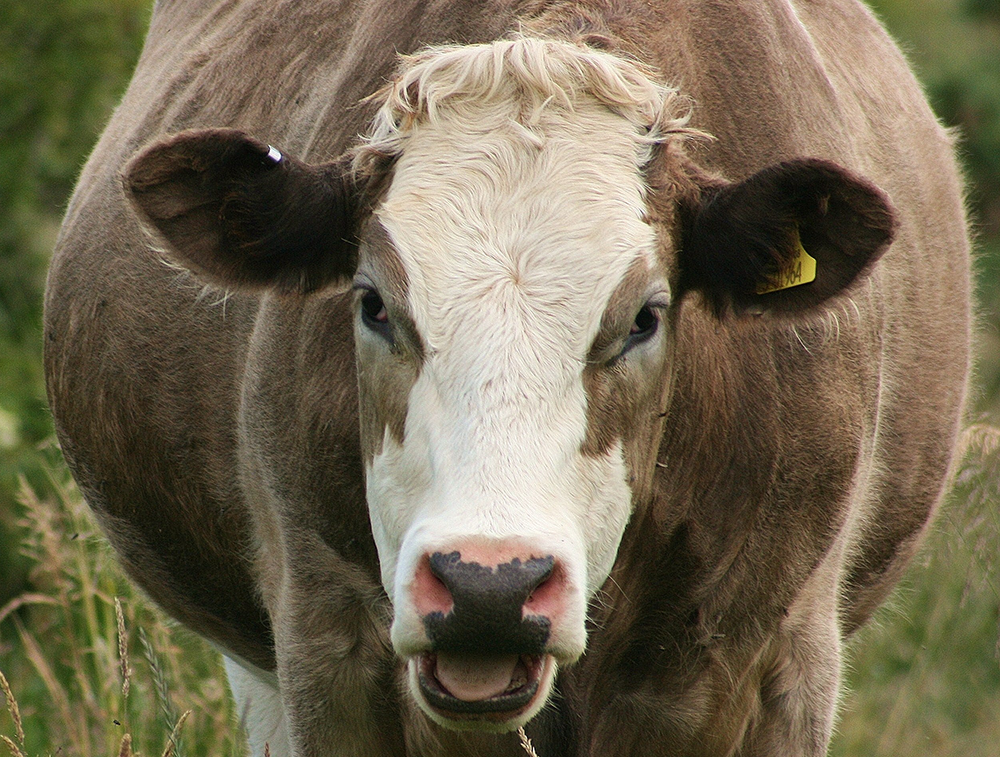
Cows belch methyl hydride, a heat-trapping gas, into the air. (Photo: Andy Muir; Artistic Eatables two.0)
LAPPÉ: Economists like to call it the externalities, and I similar to telephone call it "the things that the producers aren't having to pay for". And then that manure running off into our waterways or the nitrogen running off from cornfields and causing dead zones in the Gulf of Mexico—all of those ecology impacts are beingness paid for by united states, the taxpayers, by cleanup dollars, past federal programs from the Environmental Protection Agency and and so on. So there'due south incredible costs of production that only aren't being born by the companies, and therefore, we don't see it on the price tag of beefiness at the supermarket.
CURWOOD: American culture likes beef. Information technology's a large and of import repast. "Bring on the steak," many folks say. How do you lot make a cultural modify to align with the things you're talking almost it?

Anna Lappé is author of Diet for a Hot Planet, and co-founder of the Real Food Media Project and the Small-scale Planet Institute. (Photo: Courtesy of Anna Lappé)
LAPPÉ: Yous know, I call back the point isn't that were saying, information technology's abstinence. We're not maxim, we all take to never eat beef again. It doesn't hateful taking meat completely out of your nutrition or off your plate, only really thinking of beef as maybe a treat you give yourself sometimes, but non something y'all eat very ofttimes; and thinking nigh how to center your meals around found-based foods; how to find incredibly rich protein sources from plant foods as opposed to meat. But the other affair that I like to remind people is that there are other things we can practice to reduce our climate footprint of our meals, and that'due south doing things like reducing the food that we waste, reducing the amount of food nosotros consume that have been grown with fossil fuel intensive production systems. And so we can also think most reducing the processed foods we're eating. In that location's a lot of ingredients in processed foods that likewise have a really big climate impact. It'southward really kind of the principles of good healthy eating that eating a healthy diet: means eating plant foods, vegetables and fruits, trying to swallow foods in season, trying to cook your own food and to reduce the amount of beef on your plate as well. And then these are choices that are really proficient for bodies and they're also good for the planet.
CURWOOD: Anna Lappé is author of "Nutrition for a Hot Planet" and co-founder of the Existent Food Media Projection. Thank you and then much, Anna, for taking the time today.
LAPPÉ: Thank you.
Links
Read the National University of Sciences study that added up the bulky burden on the environs.
Anna Lappé co-founded the Minor Planet Institute with her female parent, author and activist Frances Moore Lappé
Check out our 1995 interview with Frances Moore Lappé
Living on Earth wants to hear from yous!
P.O. Box 990007
Prudential Station
Boston, MA, USA 02199
Phone: 1-617-287-4121
E-mail: comments@loe.org
Newsletter [Click here]
Donate to Living on Earth!
Living on Earth is an independent media plan and relies entirely on contributions from listeners and institutions supporting public service. Please donate now to preserve an contained environmental voice.
Newsletter
Living on Earth offers a weekly delivery of the show'south rundown to your mailbox. Sign up for our newsletter today!
 Sailors For The Sea: Be the change you desire to sea.
 Creating positive outcomes for future generations.
 Innovating to make the earth a improve, more sustainable place to live. Listen to the race to 9 billion
 The Grantham Foundation for the Protection of the Environment: Committed to protecting and improving the health of the global environs.
 Free energy Foundation: Serving the public interest by helping to build a strong, clean energy economy.
 Contribute to Living on Earth and receive, as our gift to you lot, an archival print of one of Mark Seth Lender's extraordinary wildlife photographs. Follow the link to run into Mark'south current collection of photographs.
 Purchase a signed re-create of Marker Seth Lender's book Smeagull the Seagull & support Living on World
Source: https://www.loe.org/shows/segments.html?programID=14-P13-00031&segmentID=2
0 Response to "Beef It's What's for Dinner Cattletoday.com"
Post a Comment