What Are the Chances That Toba Erupts Again
| Youngest Toba eruption | |
|---|---|
 Artist'due south impression of the eruption from almost 42 kilometres (26 mi) above Northern Sumatra | |
| Volcano | Toba Caldera Complex |
| Date | 75,000 ± 900 years BP |
| Type | Ultra-Plinian |
| Location | Sumatra, Indonesia 2°41′04″N 98°52′32″Due east / ii.6845°N 98.8756°East / two.6845; 98.8756 Coordinates: 2°41′04″N 98°52′32″E / 2.6845°N 98.8756°E / 2.6845; 98.8756 |
| VEI | eight |
| Impact | Second-about contempo super-eruption; bear on disputed |
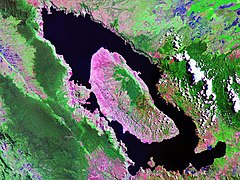 Lake Toba is the resulting crater lake | |
The Youngest Toba eruption was a Supervolcano eruption that occurred around 75,000 years agone at the site of nowadays-day Lake Toba in Sumatra, Indonesia. It is one of the Earth's largest known explosive eruptions. The Toba ending theory holds that this outcome caused a global volcanic wintertime of six to ten years and possibly a 1,000-year-long cooling episode.
In 1993, scientific discipline journalist Ann Gibbons posited that a population bottleneck occurred in human evolution about 70,000 years ago, and she suggested that this was caused by the eruption. Geologist Michael R. Rampino of New York University and volcanologist Stephen Cocky of the Academy of Hawaiʻi at Mānoa back up her suggestion. In 1998, the bottleneck theory was further developed by anthropologist Stanley H. Ambrose of the Academy of Illinois at Urbana–Champaign. Both the link and global winter theories are controversial.[one] The Youngest Toba eruption is the most closely studied supervolcanic eruption.[ii] [three]
Supervolcanic eruption [edit]
The Youngest Toba eruption occurred at the present location of Lake Toba in Indonesia, nearly 75,000 ± 900 years BP co-ordinate to potassium argon dating.[4] This eruption was the concluding and largest of four eruptions of the Toba Caldera Complex during the Quaternary period, and is also recognized from its diagnostic horizon of ashfall, the Youngest Toba tuff.[5] Information technology had an estimated Volcanic Explosivity Alphabetize (VEI) of eight (the highest rating on the scale); it fabricated a sizable contribution to the 100 km × 35 km (62 mi × 22 mi) caldera complex.[6] Dense-rock equivalent (DRE) estimates of eruptive volume for the eruption vary between 2,000 km3 (480 cu mi) and iii,000 km3 (720 cu mi); the nearly common DRE guess is 2,800 km3 (670 cu mi) of about vii×1015 kg (1.5×ten16 lb) of erupted magma, of which 800 km3 (190 cu mi) was deposited as ash autumn.[7]
The erupted mass was, at the very least, 12 times greater than that of the largest volcanic eruption in contempo history, the 1815 eruption of Mount Tambora in Republic of indonesia, which caused the 1816 "Year Without a Summer" in the Northern Hemisphere.[8] Toba'southward erupted mass deposited an ash layer of well-nigh xv centimetres (half dozen in) thick over the whole of Due south Asia. A coating of volcanic ash was also deposited over the Indian Body of water, the Arabian Sea, and the South China Sea.[9] Deep-sea cores retrieved from the South China Ocean have extended the known reach of the eruption, suggesting that the 2,800 km3 (670 cu mi) calculation of the erupted mass is a minimum value or fifty-fifty an underestimate.[x] Based on new methods (computational ash dispersal model using a 3D time-dependent tephra dispersion model, a ready of wind fields, and several tens of thickness measurements of the YTT tephra eolith), the Toba Caldera Complex possibly erupted equally much equally 13,200 km3 (three,200 cu mi) in total bulk book.[eleven] This has led to some sources labelling the Youngest Toba eruption as a "VEI-nine" event.[12]
Volcanic winter and global cooling computer models [edit]
Geologist Michael R. Rampino and volcanologist Stephen Self argue that the eruption caused a "brief, dramatic cooling or 'volcanic winter'", which resulted in a drib of the global mean surface temperature past 3–5 °C (5.4–ix.0 °F).[thirteen] Show from Greenland ice cores indicates a i,000-year period of low δ eighteenO and increased dust deposition immediately following the eruption. The eruption may have acquired this ane,000-twelvemonth period of cooler temperatures (stadial), two centuries of which could be deemed for by the persistence of the Toba stratospheric loading.[xiv] Rampino and Self believe that global cooling was already underway at the time of the eruption, simply that the process was tedious; the Youngest Toba tuff "may have provided the extra 'kick' that caused the climate system to switch from warm to common cold states".[15] Although Clive Oppenheimer rejects the hypothesis that the eruption triggered the final glaciation,[16] he agrees that it may take been responsible for a millennium of cool climate prior to the 19th Dansgaard–Oeschger event.[17]
Co-ordinate to Alan Robock, who has besides published nuclear winter papers, the Toba eruption did non precipitate the terminal glacial period. All the same, assuming an emission of five.iv billion tonnes (6 billion short tons) of sulphur dioxide, his computer simulations concluded that a maximum global cooling of approximately xv °C (27 °F) occurred for iii years after the eruption, and that this cooling would concluding for decades, devastating life.[eighteen] Considering the saturated adiabatic lapse rate is four.9 °C/1,000 grand (1.five °C/1,000 ft; two.7 °F/i,000 ft) for temperatures to a higher place freezing,[xix] the tree line and the snow line were effectually 3,000 m (nine,800 ft) lower at this time.[ where? ] The climate recovered over a few decades, and Robock institute no show that the one,000-year cold menstruum seen in Greenland ice core records had resulted from the Toba eruption. In contrast, Oppenheimer believes that estimates of a drop in surface temperature by iii–v °C (5.4–nine.0 °F) are probably too high, and he suggests that temperatures dropped only by 1 °C (i.8 °F).[20] Robock has criticized Oppenheimer'southward assay, arguing that it is based on simplistic T-forcing relationships.[xviii]
Despite these different estimates, scientists concur that a supervolcanic eruption of the scale at the Toba Caldera Complex must have led to very extensive ash-fall layers and injection of noxious gases into the atmosphere, with worldwide effects on weather and climate.[21] In addition, the Greenland water ice core data brandish an precipitous climatic change effectually this fourth dimension,[22] but there is no consensus that the eruption direct generated the 1,000-year cold period seen in Greenland or triggered the last glaciation.[23]
Concrete data confronting the wintertime hypothesis [edit]
In 2013 archaeologists led past Christine Lane reported finding a microscopic layer of glassy volcanic ash in sediments of Lake Malawi, and definitively linked the ash to the 75,000-yr-old eruption at the Toba Caldera Complex, but establish no modify in fossil type close to the ash layer, something that would be expected post-obit a astringent volcanic winter. They ended that the eruption did not significantly alter the climate of Due east Africa,[24] [25] attracting criticism from Richard Roberts.[26] Lane explained, "We examined smear slides at a ii-millimetre (0.079 in) interval, respective to subdecadal resolution, and X-ray fluorescence scans run at 200-micrometre (0.0079 in) intervals correspond to subannual resolution. We observed no obvious change in sediment limerick or Fe/Ti ratio, suggesting that no thermally driven overturn of the h2o column occurred following the Toba supereruption."[27] In 2015, a new report on the climate of East Africa supported Lane's conclusion that at that place was "no significant cooling associated with Mount Toba".[28]
A 2018 study by Republic of chad Yost and colleagues of cores from Lake Malawi dating to the period of the Youngest Toba eruption showed no evidence of a volcanic winter, and they argue that there was no effect on African humans.[29] In the view of John Hawks, the study confirms evidence from a variety of studies that the eruption did non have a major climatic effect or whatever issue on human numbers.[thirty]
Genetic bottleneck theory [edit]
Genetic bottleneck in humans [edit]
The Youngest Toba eruption has been linked to a genetic bottleneck in homo evolution about 70,000 years agone,[31] [32] which may have resulted in a severe reduction in the size of the total human population due to the effects of the eruption on the global climate.[33] Co-ordinate to the genetic bottleneck theory, betwixt 50,000 and 100,000 years agone, human being populations sharply decreased to 3,000–10,000 surviving individuals.[34] [35] It is supported past some genetic evidence suggesting that today's humans are descended from a very modest population of betwixt i,000 and 10,000 breeding pairs that existed virtually lxx,000 years ago.[36] [37]
Proponents of the genetic clogging theory (including Robock) propose that the Youngest Toba eruption resulted in a global ecological disaster, including destruction of vegetation along with severe drought in the tropical rainforest belt and in monsoonal regions. A 10-year volcanic winter triggered by the eruption could have largely destroyed the food sources of humans and caused a severe reduction in population sizes.[18] These ecology changes may accept generated population bottlenecks in many species, including hominids;[38] this in turn may take accelerated differentiation from within the smaller homo population. Therefore, the genetic differences among modernistic humans may reflect changes within the last 70,000 years, rather than gradual differentiation over hundreds of thousands of years.[39]
Other enquiry has cast doubt on a link betwixt the Toba Caldera Circuitous and a genetic bottleneck. For example, ancient stone tools in southern India were institute above and beneath a thick layer of ash from the Youngest Toba eruption and were very like across these layers, suggesting that the dust clouds from the eruption did non wipe out this local population.[40] [41] [42] Additional archaeological prove from southern and northern Republic of india as well suggests a lack of bear witness for effects of the eruption on local populations, leading the authors of the study to conclude, "many forms of life survived the supereruption, contrary to other research which has suggested significant brute extinctions and genetic bottlenecks".[43] However, evidence from pollen analysis has suggested prolonged deforestation in South Asia, and some researchers accept suggested that the Toba eruption may have forced humans to prefer new adaptive strategies, which may take permitted them to replace Neanderthals and "other archaic homo species".[44] [45]
Additional caveats include difficulties in estimating the global and regional climatic impacts of the eruption and lack of conclusive evidence for the eruption preceding the bottleneck.[46] Furthermore, genetic analysis of Alu sequences across the entire man genome has shown that the effective homo population size was less than 26,000 at 1.2 1000000 years ago; possible explanations for the depression population size of human ancestors may include repeated population bottlenecks or periodic replacement events from competing Homo subspecies.[47]
Genetic bottlenecks in other mammals [edit]
Some evidence points to genetic bottlenecks in other animals in the wake of the Youngest Toba eruption. The populations of the Eastern African chimpanzee,[48] Bornean orangutan,[49] cardinal Indian macaque,[l] cheetah and tiger,[51] all recovered from very small populations around 70,000–55,000 years ago.
The separation of the nuclear gene pools of eastern lowland gorilla and western lowland gorilla have been estimated to take occurred about 77,700 years ago.[52]
Migration afterwards Toba [edit]
The exact geographic distribution of anatomically modern human populations at the time of the eruption is not known, and surviving populations may accept lived in Africa and later on migrated to other parts of the earth. Analyses of mitochondrial Dna have estimated that the major migration from Africa occurred 60,000–70,000 years agone,[53] consequent with dating of the Youngest Toba eruption to around 75,000 years ago.[ commendation needed ]
Encounter also [edit]
- Early human being migrations – Spread of humans from Africa through the world
- Most recent common ancestor – Most contempo individual from which all organisms in a group are directly descended
- Quaternary extinction
- Recent African origin of modern humans – "Out of Africa" theory of the early on migration of humans
- Timeline of volcanism on Earth
- Wallace Line – Faunal purlieus line separating the realms of Asia and Wallacea, a transitional zone between Asia and Australia
Citations and notes [edit]
- ^ "Toba super-volcano catastrophe idea 'dismissed'". BBC News. xxx April 2013. Retrieved 2017-01-08 .
- Choi, Charles Q. (2013-04-29). "Toba Supervolcano Not to Blame for Humanity's Almost-Extinction". Livescience.com . Retrieved 2017-01-08 .
- ^
- Chesner & others 1991, p. 200; Jones 2007, p. 174; Oppenheimer 2002, pp. 1593–1594; Ninkovich & others 1978
- "The Toba Supervolcano And Homo Development". Toba.arch.ox.air-conditioning.great britain. Archived from the original on 2012-12-12. Retrieved 2013-08-05 .
- ^ "The Geological Society : Super-eruptions" (PDF). Geo.mtu.edu. Retrieved 2015-03-28 .
- ^
- Ninkovich & others 1978.
- Chesner & others 1991.
- ^
- Chesner & others 1991, p. 200; Jones 2007, p. 174; Oppenheimer 2002, pp. 1593–1594; Ninkovich & others 1978
- Rose & Chesner 1987, p. 913; Zielinski & others 1996.
- ^ Oppenheimer 2002, p. 1593.
- ^ Jones 2007, p. 174; Rose & Chesner 1987, p. 913.
- ^ Petraglia & others 2007, p. 114; Zielinski & others 1996, p. 837.
- ^ Jones 2007, p. 173
- ^ Jones 2007, p. 174; Oppenheimer 2002. pp. 1593–1596.
- ^ Antonio Costa; Victoria C. Smith; Giovanni Macedonio; Naomi E. Matthews (2014). "The magnitude and bear upon of the Youngest Toba Tuff super-eruption". Frontiers in Globe Scientific discipline. two: 16. Bibcode:2014FrEaS...2...16C. doi:10.3389/feart.2014.00016.
- ^ Shinji Takarada; Hideo Hoshizumi (2020). "Distribution and Eruptive Volume of Aso-4 Pyroclastic Density Current and Tephra Autumn Deposits, Japan: A M8 Super-Eruption". Frontiers in Earth Science. 8: 170. Bibcode:2020FrEaS...8..170T. doi:10.3389/feart.2020.00170.
- ^ Rampino & Self 1993a, passim.
- ^ Zielinski & others 1996, pp. 837–840.
- ^ Rampino & Cocky 1992, p. 52; Rampino & Cocky 1993a, p. 277.
- ^ Robock & others 2009 seem to agree on that.
- ^ Oppenheimer 2002, p. 1606.
- ^ a b c Robock & others 2009.
- ^ IUPAC, Compendium of Chemical Terminology, 2nd ed. (the "Gilt Book") (1997). Online corrected version: (2006–) "adiabatic lapse rate". doi:10.1351/goldbook.A00144
- ^ Oppenheimer 2002, pp. 1593, 1601.
- ^ Cocky & Blake 2008, p. 41.
- ^ Zielinski & others 1996, p. 837.
- ^ Robock & others 2009 (page?).
- ^ "Dubiousness over 'volcanic winter' after Toba super-eruption". Phys.org. 2013-05-02. Retrieved 2013-08-05 .
- ^ Lane, C. S.; Chorn, B. T.; Johnson, T. C. (2013). "Ash from the Toba supereruption in Lake Malawi shows no volcanic winter in Due east Africa at 75 ka". Proceedings of the National University of Sciences. 110 (twenty): 8025–8029. Bibcode:2013PNAS..110.8025L. doi:10.1073/pnas.1301474110. PMC3657767. PMID 23630269.
- ^ Roberts, R. M.; Storey, One thousand.; Haslamc, Thousand. (2013). "Toba supereruption: Historic period and impact on East African ecosystems". Proceedings of the National Academy of Sciences. 110 (33): E3047. Bibcode:2013PNAS..110E3047R. doi:10.1073/pnas.1308550110. PMC3746893. PMID 23792580.
- ^ Lane, C. S. (2013). "Respond to Roberts et al.: A subdecadal record of paleoclimate around the Youngest Toba Tuff in Lake Malawi". Proceedings of the National Academy of Sciences. 110 (33): E3048. Bibcode:2013PNAS..110E3048L. doi:10.1073/pnas.1309815110. PMC3746898. PMID 24137629.
- ^ Jackson, 50. J.; Stone, J. R.; Cohen, A. S.; Yost, C. L. (2015). "High-resolution paleoecological records from Lake Republic of malaŵi evidence no pregnant cooling associated with the Mount Toba supereruption at ca. 75 ka". Geology. 43 (9): 823–826. Bibcode:2015Geo....43..823J. doi:x.1130/G36917.1.
- ^ Yost, Republic of chad; et al. (March 2018). "Subdecadal phytolith and charcoal records from Lake Malawi, East Africa imply minimal furnishings on human being evolution from the ∼74 ka Toba supereruption". Journal of Man Development. Elsevier. 116: 75–94. doi:10.1016/j.jhevol.2017.11.005. PMID 29477183.
- ^ Hawks, John (9 February 2018). "The so-chosen Toba bottleneck didn't happen". john hawks weblog.
- ^ Gibbons 1993, p. 27
- ^ Rampino & Cocky 1993a
- ^ Ambrose 1998, passim; Gibbons 1993, p. 27; McGuire 2007, pp. 127–128; Rampino & Ambrose 2000, pp. 78–fourscore; Rampino & Self 1993b, pp. 1955.
- ^ Ambrose 1998; Rampino & Ambrose 2000, pp. 71, 80.
- ^ "Science & Nature – Horizon – Supervolcanoes". BBC.co.uk. Retrieved 2015-03-28 .
- ^ "When humans faced extinction". BBC. 2003-06-09. Retrieved 2007-01-05 .
- ^ M.R Rampino and South.Self, Nature 359, 50 (1992)
- ^ Rampino & Ambrose 2000, p. 80.
- ^ Ambrose 1998, pp. 623–651.
- ^ "Mount Toba Eruption – Aboriginal Humans Unscathed, Report Claims". Anthropology.net. half-dozen July 2007. Retrieved 2008-04-20 .
- ^ Sanderson, Katherine (July 2007). "Super-eruption: no problem?". Nature: news070702–fifteen. doi:10.1038/news070702-xv. S2CID 177216526. Archived from the original on December 7, 2008.
- ^ John Hawks (v July 2007). "At terminal, the death of the Toba bottleneck". john hawks blog.
- ^ See as well "Newly Discovered Archaeological Sites in India Reveals Ancient Life earlier Toba". Anthropology.net. 25 February 2010. Retrieved 28 February 2010.
- ^ "Supervolcano Eruption In Sumatra Deforested Republic of india 73,000 Years ago". ScienceDaily. 24 November 2009.
- ^ Williams & others 2009.
- ^ Oppenheimer 2002, pp. 1605, 1606.
- ^ If these results are accurate, then, even before the emergence of Human being sapiens in Africa, Homo erectus population was unusually small when the species was spreading around the world. See Huff & others 2010, p.six; Gibbons 2010.
- ^ Goldberg 1996
- ^ Steiper 2006
- ^ Hernandez & others 2007
- ^ Luo & others 2004
- ^ Thalman & others 2007
- ^ "New 'Molecular Clock' Aids Dating Of Human Migration History". ScienceDaily. 22 June 2009. Retrieved 2009-06-30 .
References [edit]
- Ambrose, Stanley H. (1998). "Late Pleistocene human population bottlenecks, volcanic winter, and differentiation of modern humans". Journal of Human Evolution. 34 (half dozen): 623–651. doi:10.1006/jhev.1998.0219. PMID 9650103.
- Chesner, C.A.; Westgate, J.A.; Rose, Westward.I.; Drake, R.; Deino, A. (March 1991). "Eruptive History of Earth'due south Largest Quaternary caldera (Toba, Indonesia) Antiseptic" (PDF). Geology. 19 (3): 200–203. Bibcode:1991Geo....19..200C. doi:10.1130/0091-7613(1991)019<0200:EHOESL>two.iii.CO;2.
- Gibbons, Ann (1 October 1993). "Pleistocene Population Explosions". Science. 262 (5130): 27–28. Bibcode:1993Sci...262...27G. doi:10.1126/science.262.5130.27. PMID 17742951.
- Gibbons, Ann (19 January 2010). "Human Ancestors Were an Endangered Species". ScienceNow.
- Goldberg, T.50. (1996). "Genetics and biogeography of E African chimpanzees (Pan troglodytes schweinfurthii)" (PhD). Harvard University, unpublished.
- Hernandez, R.D.; Hubisz, M.J.; Wheeler, D.A.; Smith, D.One thousand.; Ferguson, B.; et al. (2007). "Demographic histories and patterns of linkage disequilibrium in Chinese and Indian Rhesus macaques". Scientific discipline. 316 (5822): 240–243. Bibcode:2007Sci...316..240H. doi:10.1126/science.1140462. PMID 17431170.
- Huff, Chad. D; Xing, Jinchuan; Rogers, Alan R.; Witherspoon, David; Jorde, Lynn B. (19 Jan 2010). "Mobile Elements Reveal Small Population Size in the Aboriginal Ancestors of Human being Sapiens". Proceedings of the National Academy of Sciences. 107 (5): 2147–2152. Bibcode:2010PNAS..107.2147H. doi:10.1073/pnas.0909000107. PMC2836654. PMID 20133859.
- Jones, Southward. C. (2007). "The Toba Supervolcanic Eruption: Tephra-Autumn Deposits in India and Paleoanthropological Implications". In Petraglia, Yard. D.; Allchin, B. (eds.). The Development and History of Human Populations in South Asia. Springer. pp. 173–200. ISBN978-1-4020-5561-four.
- Luo, Southward.-J.; Kim, J.-H.; Johnson, W.Due east.; Van der Walt, J.; Martenson, J.; et al. (2004). "Phylogeography and genetic ancestry of tigers (Panthera tigris)". PLOS Biological science. 2 (12): 2275–2293. doi:10.1371/periodical.pbio.0020442. PMC534810. PMID 15583716.
- Luo, Shu-Jin; Zhang, Yue; Johnson, Warren East.; Miao, Lin; Martelli, Paolo; et al. (2014). "Sympatric Asian felid phylogeography reveals a major Indochinese-Sundaic divergence". Molecular Ecology. 23 (eight): 2072–2092. doi:10.1111/mec.12716. ISSN 0962-1083. PMID 24629132. S2CID 40030155.
- McGuire, Due west.J. (2007). "The GGE Threat: Facing and Coping with Global Geophysical Events". In Bobrowsky, Peter T.; Rickman, Hans (eds.). Comet/Asteroid Impacts and Homo Order: an Interdisciplinary Arroyo. Springer. pp. 123–141. Bibcode:2007caih.book.....B. ISBN978-3-540-32709-7.
- Ninkovich, D.; North.J. Shackleton; A.A. Abdel-Monem; J.D. Obradovich; Thou. Izett (7 Dec 1978). "K−Ar historic period of the late Pleistocene eruption of Toba, north Sumatra". Nature. 276 (5688): 574–577. Bibcode:1978Natur.276..574N. doi:10.1038/276574a0. S2CID 4364788.
- Oppenheimer, Clive (August 2002), "Limited global change due to largest known Quaternary eruption, Toba ≈74 kyr BP?", Quaternary Science Reviews, 21 (fourteen–15): 1593–1609, Bibcode:2002QSRv...21.1593O, doi:ten.1016/S0277-3791(01)00154-eight
- Petraglia, Thou.; Korisettar, R.; Boivin, N.; Clarkson, C.; Ditchfield, P.; et al. (6 July 2007). "Center Paleolithic Assemblages from the Indian Subcontinent Before and After the Toba Super-eruption" (PDF). Science. 317 (5834): 114–116. Bibcode:2007Sci...317..114P. doi:10.1126/science.1141564. PMID 17615356. S2CID 20380351.
- Rampino, M. R.; Ambrose, Due south. H. (2000). "Volcanic winter in the Garden of Eden: The Toba supereruption and the late Pleistocene homo population crash". In McCoy, F. W.; Heiken, G. (eds.). Volcanic Hazards and Disasters in Human being Antiquity. Boulder, Colorado: Geological Society of America Special Paper 345. doi:10.1130/0-8137-2345-0.71. ISBN0-8137-2345-0.
- Rampino, Michael R.; Cocky, Stephen (ii September 1992). "Volcanic Winter and Accelerated Glaciation following the Toba Super-eruption" (PDF). Nature. 359 (6390): l–52. Bibcode:1992Natur.359...50R. doi:10.1038/359050a0. S2CID 4322781. Archived from the original (PDF) on xx Oct 2011.
- Rampino, Michael R.; Self, Stephen (1993). "Climate–Volcanism Feedback and the Toba Eruption of ~74,000 Years agone" (PDF). Fourth Research. 40 (3): 269–280. Bibcode:1993QuRes..xl..269R. doi:10.1006/qres.1993.1081. Archived from the original (PDF) on 2011-ten-21.
- Rampino, Michael R.; Cocky, Stephen (24 December 1993). "Bottleneck in the Human being Evolution and the Toba Eruption". Science. 262 (5142): 1955. Bibcode:1993Sci...262.1955R. doi:10.1126/science.8266085. PMID 8266085.
- Robock, A.; Ammann, C.M.; Sultanate of oman, 50.; Shindell, D.; Levis, S.; Stenchikov, Chiliad. (2009). "Did the Toba Volcanic Eruption of ~74k BP Produce Widespread Glaciation?". Journal of Geophysical Research. 114 (D10): D10107. Bibcode:2009JGRD..11410107R. doi:10.1029/2008JD011652.
- Rose, W.I.; Chesner, C.A. (October 1987). "Dispersal of Ash in the Peachy Toba Eruption, 75 ka" (PDF). Geology. 15 (10): 913–917. Bibcode:1987Geo....xv..913R. doi:10.1130/0091-7613(1987)15<913:DOAITG>ii.0.CO;ii.
- Self, Stephen; Blake, Stephen (February 2008). "Consequences of Explosive Supereruptions". Elements. iv (1): 41–46. doi:10.2113/GSELEMENTS.iv.1.41.
- Steiper, Chiliad.E. (2006). "Population history, biogeography, and taxonomy of orangutans (Genus: Pongo) based on a population genetic meta-analysis of multiple loci". Journal of Human Development. 50 (five): 509–522. doi:10.1016/j.jhevol.2005.12.005. PMID 16472840.
- Thalman, O.; Fisher, A.; Lankester, F.; Pääbo, S.; Vigilant, 50. (2007). "The circuitous history of gorillas: insights from genomic data". Molecular Biological science and Evolution. 24: 146–158. doi:10.1093/molbev/msl160. PMID 17065595.
- Williams, Martin A.J.; Stanley H. Ambrose; Sander van der Kaars; Carsten Ruehlemann; Umesh Chattopadhyaya; Jagannath Pal; Parth R. Chauhan (30 December 2009). "Environmental bear upon of the 73 ka Toba super-eruption in South Asia". Palaeogeography, Palaeoclimatology, Palaeoecology. Elsevier. 284 (3–four): 295–314. Bibcode:2009PPP...284..295W. doi:10.1016/j.palaeo.2009.x.009.
- Zielinski, G.A.; Mayewski, P.A.; Meeker, L.D.; Whitlow, Due south.; Twickler, Thou.S.; Taylor, K. (1996). "Potential Atmospheric Impact of the Toba Mega‐Eruption ~71,000 years ago" (PDF). Geophysical Research Letters. 23 (8): 837–840. Bibcode:1996GeoRL..23..837Z. doi:10.1029/96GL00706. Archived from the original (PDF) on July 18, 2011.
Further reading [edit]
- Prothero, Donald R. (2018). When Humans Nearly Vanished: The Catastrophic Explosion of the Toba Volcano. Washington: Smithsonian Books. ISBN1588346358. OCLC 1020313538.
External links [edit]
- Population Bottlenecks and Volcanic Wintertime
- "Toba Volcano by George Weber". Archived from the original on April 22, 2011. Retrieved June 1, 2006.
- "The proper study of mankind" – Article in The Economist
- Homepage of Professor Stanley H. Ambrose, including bibliographic informatio on the two papers he has published on the Toba ending theory
- "Aboriginal 'Volcanic Wintertime' Tied To Rapid Genetic Departure in Humans", ScienceDaily (Sep. 8, 1998) – Article based on news release regarding Ambrose's newspaper
- Mount Toba: Late Pleistocene human population bottlenecks, volcanic winter, and differentiation of modernistic humans by Professor Stanley H. Ambrose, Section of Anthropology, University Of Illinois, Urbana, USA; Extract from "Periodical of Human being Evolution" [1998] 34, 623–651
- Journey of Flesh past The Bradshaw Foundation – includes discussion on Toba eruption, DNA and human migrations
- Geography Predicts Human Genetic Diversity ScienceDaily (Mar. 17, 2005) – By analyzing the relationship between the geographic location of electric current human populations in relation to E Africa and the genetic variability within these populations, researchers have found new bear witness for an African origin of modern humans.
- Out of Africa – Bacteria, As Well: Homo Sapiens And H. Pylori Jointly Spread Beyond The Globe ScienceDaily (February. sixteen, 2007) – When man made his mode out of Africa some 60,000 years ago to populate the world, he was not alone: He was accompanied by the bacterium Helicobacter pylori...; illus. migration map.
- Magma 'Pancakes' May Have Fueled Toba Supervolcano
- Youtube video "Stone Age Apocalypse"
Source: https://en.wikipedia.org/wiki/Toba_catastrophe_theory
0 Response to "What Are the Chances That Toba Erupts Again"
Post a Comment